
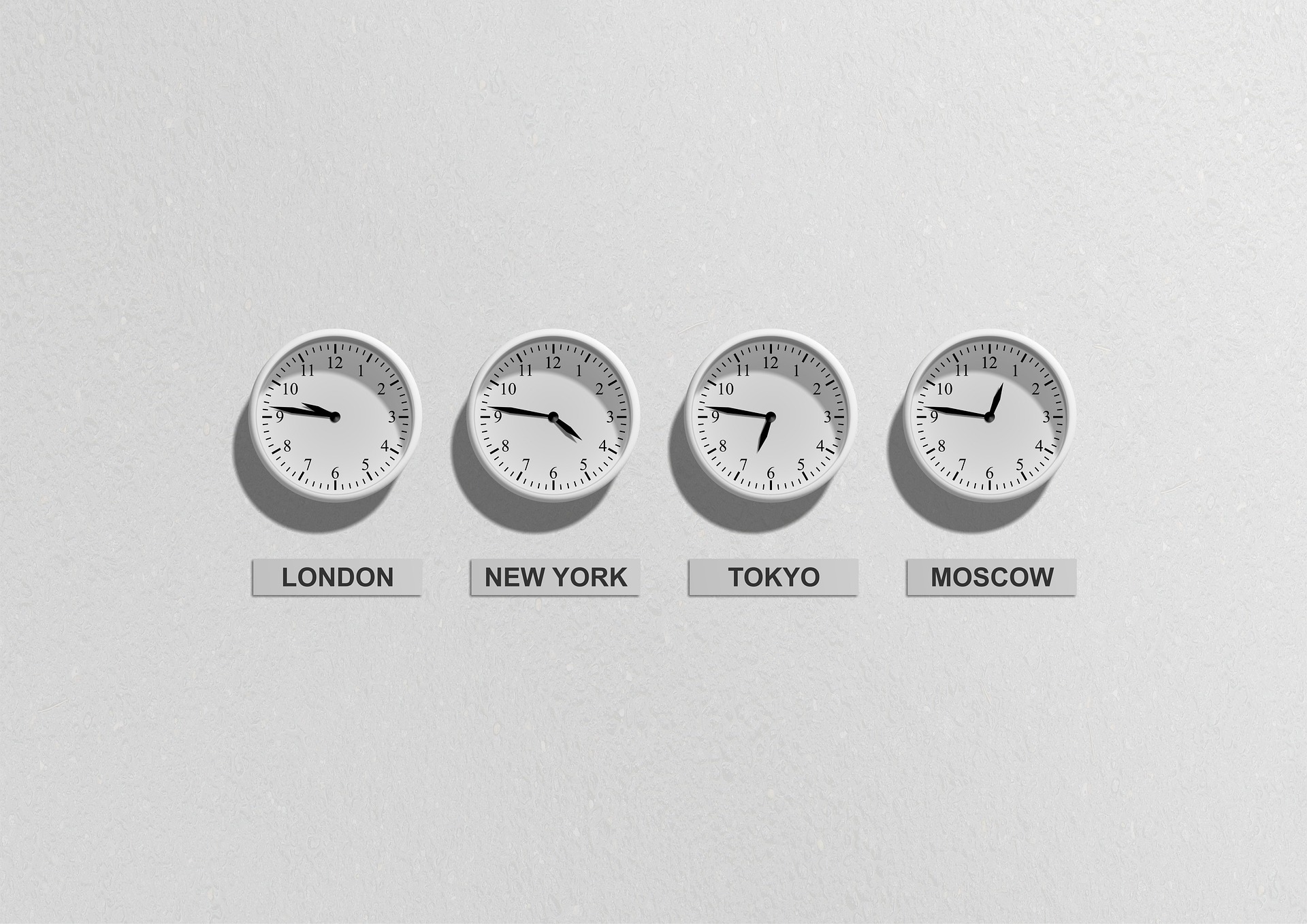
Send a calendar invitation to someone in another country, and it resolves itself. Their morning, your afternoon, no negotiation. It is one of the few pieces of international coordination that works so smoothly it is invisible.
It is also about 140 years old, which makes it younger than the telephone. And almost every boundary on the map is a decision somebody argued about.
Noon Used To Be A Local Fact
For nearly all of history, time was astronomical and local. Noon was when the sun was highest where you were standing, which meant a town twenty kilometers east had a slightly different noon. Nobody minded, because nothing moved fast enough for the difference to matter.
Railways broke this. A timetable is a promise about a shared clock, and a train crossing several towns’ local noons in an afternoon makes that promise incoherent — and, when two trains are on one track, dangerous. British railways adopted a single standard time decades before the country did. In the United States, the fix came directly from the industry: on 11 October 1883, railway executives meeting in Chicago agreed to divide the continent into five zones based on Greenwich.
Note the order. The railways standardized time, and governments ratified it afterward, in some cases much later — US federal law did not adopt standard time until 1918.
Greenwich Won A Vote
The international layer arrived at the International Meridian Conference in Washington in October 1884, where delegates from twenty-five nations agreed that a single prime meridian was desirable and that it should be the one through Greenwich.
The choice was not scientific. It was commercial: a large majority of the world’s shipping already used charts based on Greenwich, so picking anything else meant reprinting the maritime world. France, which had its own meridian and its own considerable opinion about British naval hegemony, declined to endorse it and continued using Paris Mean Time for decades. When France finally aligned in 1911, it did so by legally defining French time as Paris Mean Time retarded by nine minutes and twenty-one seconds — which is Greenwich, without having to say the word.
That is the tone of the whole subject. The technical question was settled in a morning. The political question has never entirely been.
The Map Follows Borders, Not The Sun
If time zones were geography, they would be 24 tidy strips of 15 degrees each. They are not, because a country picks its own offset, and the choice says something.
China spans about sixty degrees of longitude — five zones’ worth — and has run on a single offset, UTC+8, since 1949. In the far west, solar noon can fall in the middle of the afternoon. Many people in Xinjiang keep an unofficial local time two hours behind the legal one, so asking what time it is can produce two answers, and which one you give is not a neutral act.
India runs one offset, UTC+5:30, across a country wide enough for two. Nepal sits at UTC+5:45, one of very few quarter-hour offsets on earth, keyed to a meridian near Kathmandu — and functionally a statement about not being on Indian time. Samoa skipped a day entirely at the end of 2011, moving across the date line to sit on the same side as Australia and New Zealand, because that is where its trade was.
None of these are errors. They are all the same move: choosing whose day you share.
The Spain Story Is Wrong
Spain is the example everyone reaches for. Geographically, most of the country belongs with Britain and Portugal on GMT; it runs instead on Central European Time. The universally repeated explanation is that Franco moved the clocks in 1940 as a gesture of alignment with Nazi Germany, and that Spain has never undone it.
The second half is true. The first half does not survive contact with the record.
The Spanish order came in March 1940 and was framed as bringing the country into line with other European nations — which is exactly what was happening. Britain, France, Belgium, the Netherlands and Portugal all advanced their clocks that year, as wartime energy-saving measures. Spain’s own Republican government had done something similar in 1938. And the detail that undoes the story cleanly: Germany moved to summer time in April 1940, putting it an hour ahead of Spain again. If the point was to match Berlin, it did not match Berlin.
The astronomer Pere Planesas, who spent years on Spanish timekeeping records at the national observatory, has called the Hitler interpretation a hoax. The measure was presented as temporary. It was simply never reversed, which is the least dramatic and most common reason for anything in this field.
The duller story is the more useful one: a wartime energy measure, plus eighty years of nobody wanting to bear the cost of changing it back.
Why It Still Matters
Because the argument is live. Spain periodically debates returning to GMT. The European Union voted to abolish seasonal clock changes and then stalled, because agreeing to stop is easy and agreeing on which time to stop at would fracture the single market into inconvenient blocks. Countries continue to shift offsets for reasons of trade and identity.
And because the whole system rests on an observation worth keeping: a time zone is not a measurement. It is a claim about who you do business with, dressed up as astronomy. The sun does not recognize a single one of these lines.

Leave a Reply