
Stand beside a container train and look along the tops of the boxes. They are all the same width. The steel castings at the corners line up so precisely that a crane driver in Rotterdam can lift a box built in Qingdao and set it on a chassis bound for Chicago without measuring anything. World container traffic came to roughly 170 million twenty-foot equivalent units in 2024, and the reason any of it works is the shipping container standard. The man usually credited with inventing the container did not write it. A committee did, and it began by throwing out his box.
The Box Was Not the Invention
On April 26, 1956, a converted World War II tanker called the Ideal-X sailed from Port Newark for Houston carrying fifty-eight 35-foot trailer bodies on deck above a normal load of liquid cargo. That voyage is reasonably treated as the beginning of container shipping. It was not the invention of the container.
The proof is in Malcom McLean’s own paperwork. When the US Patent Office granted patent 3,027,025 to engineer Keith Tantlinger in March 1962, assigned to McLean’s company Sea-Land Service, the examiner listed seventeen earlier patents as prior art. The oldest was filed in 1908, for a detachable body and truck for railcars. A 1933 patent was titled, plainly enough, “Container and method and means for handling cargo by such containers.” That same year the Bureau International des Containers published a first international container standard for European rail freight. The US Army was shipping CONEX boxes before Sea-Land existed.
What was new in 1956 was the system around the box: purpose-converted ships, cranes that could lift from above, chassis that took a body without its wheels, and the commercial nerve to abandon a century of loose cargo handling. Even the cost figure everyone repeats deserves a caveat. Loading loose cargo at $5.83 a ton against 15.8 cents a ton for the Ideal-X was a calculation by McLean’s own experts, and it appears elsewhere as $5.86 and 16 cents depending on who is copying whom. The direction of travel is not in doubt. The decimal places are decoration.
Every Line Picked a Different Length
Container dimensions were not set by naval architects. They were set by road and rail law. McLean’s first boxes were 33 feet long, sized to get around the narrow roads near his New Jersey base, and his second generation was 35 feet, the longest trailer then legal in every state he drove through.
Everyone else picked differently for the same kind of reason. Matson, dominant on the West Coast, built 24-foot boxes to suit California’s traffic code. Grace Line ran 17-footers for mountain roads in Latin America. SeaTrain used 27 feet. The result was that a Matson box could not be stacked on a Sea-Land box, and no chassis fitted more than one company’s fleet. Containerization was on its way to being several incompatible industries.
What the Shipping Container Standard Actually Fixed
In 1958 the American Standards Association convened a committee with the unglamorous name MH-5 to settle domestic container dimensions. Width followed road regulation. The height of 8 feet was agreed in 1959. Length was the fight. Proposals on the table were 20 and 40 feet, 12 and 24 feet, and 17 and 35 feet — each pair reflecting whose trucks and whose states were being protected. The 40-foot figure came from the railways, which at the time were permitted to move boxcars no longer than 40 feet.
When several states raised their road vehicle limit to 40 feet in 1959, the 17 and 35 pairing lost its justification and was dropped. In 1961 MH-5 settled on 8 feet by 8 feet, with lengths of 10, 20, 30 and 40 feet. ISO created technical committee TC 104 the same year, accepted the American proposal in 1962, and added 30 feet and two much shorter lengths in 1963. ISO 668 was published in 1968. Of the four lengths, 20 and 40 took over the world and 10 and 30 barely happened.
The Committee Overruled the Two Companies That Mattered
Here is where the popular story goes wrong. It usually has McLean generously handing his design to the world, which then adopted it. He did not, and it did not. MH-5 declined to include Sea-Land’s 35 feet and declined Matson’s 24 feet. Both pioneers were told their fleets were non-standard.
They did not accept it. By 1965, when the American standard appeared as MH-5.1, Sea-Land and Matson between them handled roughly 70 percent of US container traffic. Both lobbied the Department of Commerce to recognize 35 and 24 feet as well, so they could keep bidding for government cargo, and Congress amended the Merchant Marine Act in response. Sea-Land ran 35-foot boxes commercially into the 1980s. Matson, working a largely closed route to Hawaii where interchange hardly mattered, ignored the standard and kept its 24-footers.
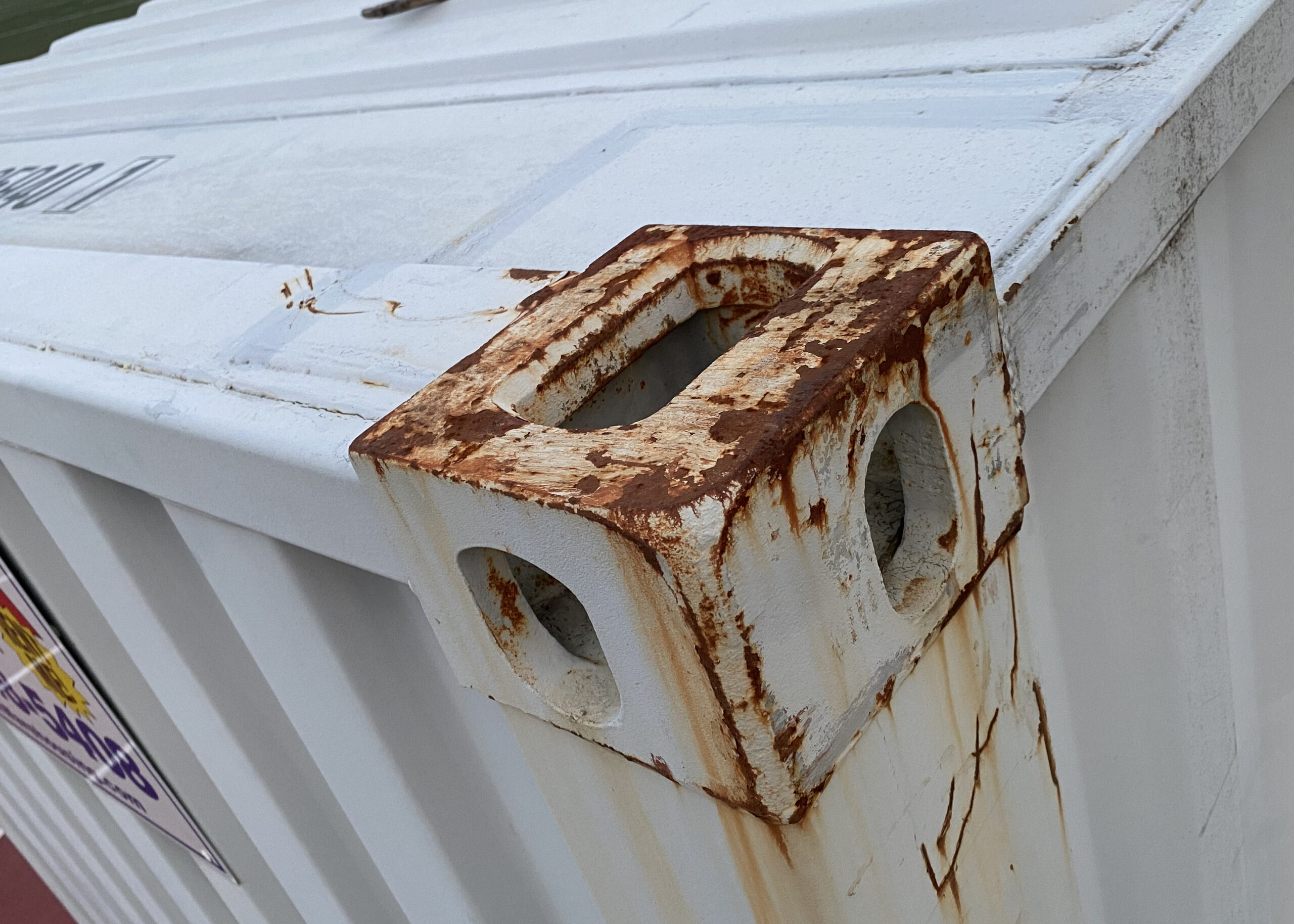
What Sea-Land did surrender was smaller and far more consequential than a length. Tantlinger had designed the corner casting and its matching twistlock in 1955, and Sea-Land owned the patent — which is exactly why ISO’s working group deadlocked in London in 1962, since a patented part cannot become an open standard. Tantlinger, by then at Fruehauf and chairing the relevant task force, went back to his former employer and asked. Sea-Land released the patent by letter dated January 29, 1963, permitting changes to the fitting’s dimensions. A modified design was accepted unanimously at The Hague in 1965 and became ISO 1161. When you look at the corner of a container, you are looking at Tantlinger’s work, given away by a company the committee had just overruled.
Why Twenty Feet Is Not Twenty Feet
A 20-foot container is not twenty feet long. It is 19 feet 10½ inches, held to a tolerance of a quarter of an inch. The missing inch and a half is the entire trick. It leaves room for the twistlocks that join two boxes end to end, so that a pair of 20s measures exactly 40 feet and their corner castings sit directly beneath the corners of the 40-footer stacked on top.
The same logic explains an oddity of 45-foot containers, which carry a second set of corner fittings 2½ feet inboard from each end, at the 40-foot positions, so they can be stacked interchangeably with 40s. The exterior size of a container matters less than where its castings are. The whole system rests on eight steel lumps meeting within a quarter of an inch.
That rigidity has a price, and it is still being paid. The 8-foot width was an American road limit from the late 1950s. In 1963 the Dutch delegation proposed 2,500 millimeters instead, legal on most European roads and worth 62 millimeters of interior width, backed by Scandinavia, Belgium, Germany, France, Italy and Spain. The United States, the United Kingdom, the Commonwealth countries and Japan voted it down. Europe has been working around that vote ever since with pallet-wide containers that claw back millimeters inside the same fixed corner geometry, while North America went the other way and runs 48- and 53-foot domestic boxes that fit almost nothing overseas. Every one of those workarounds exists because the castings cannot move. This is what happens when a standard wins completely. It stops being a decision anyone can revisit and becomes the ground everyone builds on, whether or not it was the best shape available. The paper on your desk got its proportions from a better argument than this one.

Leave a Reply