
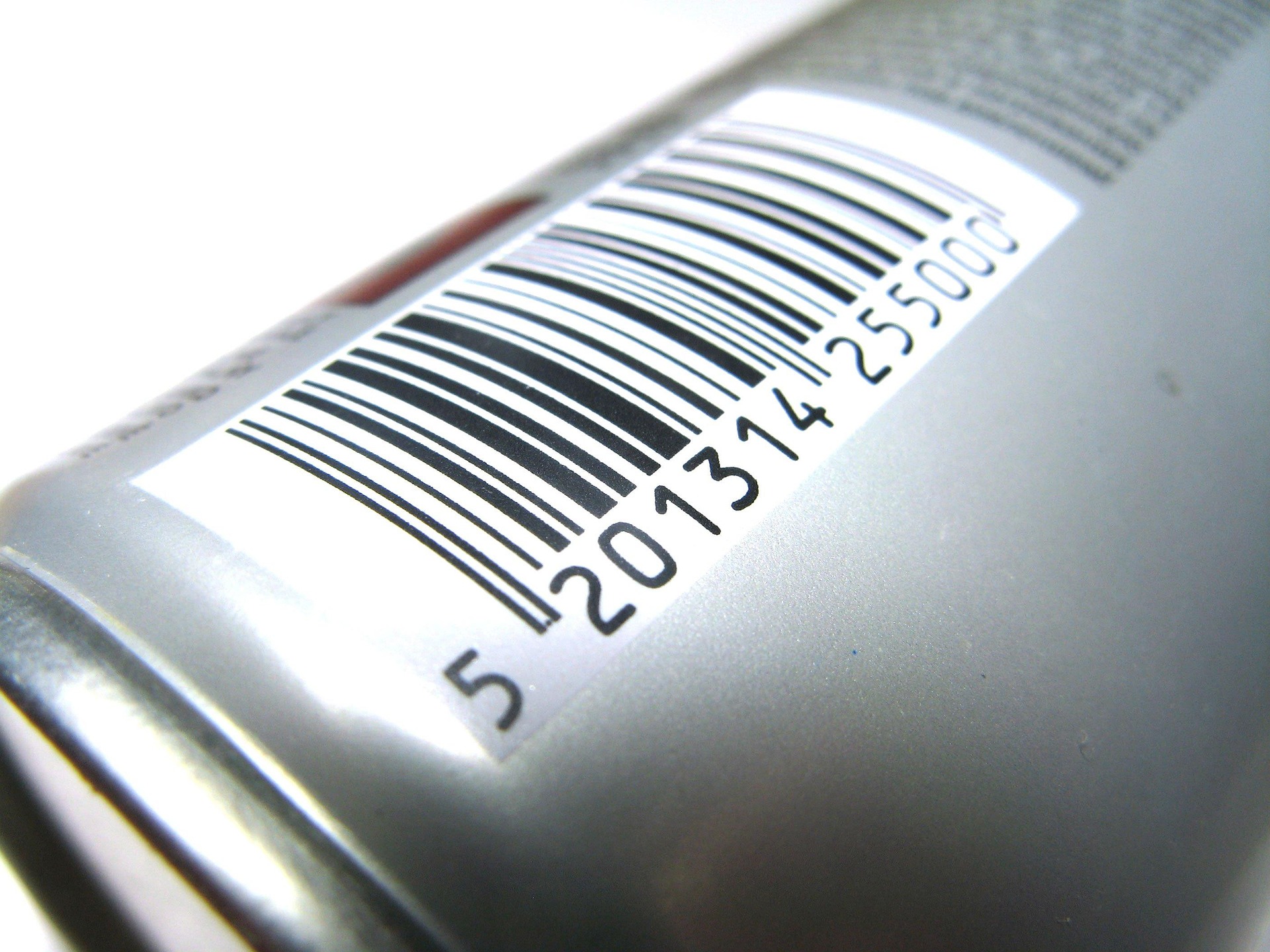
Scan a pack of gum at a self-checkout and the whole transaction takes about a second. The UPC barcode that makes it possible was picked by a committee in the spring of 1973, and by the following June a laser scanner in an Ohio supermarket was reading one off a ten-pack of Wrigley’s Juicy Fruit. Then, for most of a decade, almost nothing happened.
The UPC barcode is usually told as a story about technology catching up with an idea. Two engineers patent a scannable symbol in 1952, the world lacks lasers and cheap computers, twenty years pass, the parts arrive, and the checkout beeps. The first half of that is roughly right. The second half is where it goes wrong, because the longer delay came after the machinery worked.
A Symbol Chosen in a New York Hotel
The origin of the UPC barcode is well documented and mostly accurate as told. In 1948 Bernard Silver, a graduate student at the Drexel Institute of Technology, overheard a food chain executive asking a dean for a way to capture product information at the checkout. He and Norman Joseph Woodland worked the problem, and Woodland — on a Florida beach, thinking about Morse code — dragged four fingers through the sand and pulled dots and dashes down into narrow and wide lines.
They filed on October 20, 1949. US Patent 2,612,994, “Classifying Apparatus and Method,” was granted in October 1952 and covered both a straight-line pattern and a circular bullseye. It expired seventeen years later, on October 7, 1969. RCA owned it by then, and the standard it anticipated did not yet exist. Every UPC barcode ever printed was printed after the patent that anticipated it had lapsed.
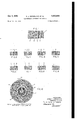
The UPC barcode in use today was settled between 1971 and 1973 by an ad hoc committee of the grocery trade, advised by McKinsey, with no government involvement whatsoever. Seven companies submitted symbols. RCA, which had run an eighteen-month trial of the bullseye in a Kroger store in Cincinnati, considered itself the obvious winner, and it had a real problem: printing presses spread ink, and a smeared bullseye becomes unreadable in most orientations. A linear code printed along the direction of its bars simply gets taller.
On March 30, 1973, in a hotel near Grand Central Station, the committee chose the rectangle IBM had submitted at the last minute. It is worth being precise about who drew it. Woodland is routinely called the father of the barcode, and he worked on IBM’s proposal as its planner, but the winning symbol was George Laurer’s, and Woodland argued for it over his own bullseye. IBM’s own account notes that neither Laurer nor the company ever patented the design.
The UPC Barcode Was Not Waiting for the Laser
Most accounts stop at 8:01 a.m. on June 26, 1974, when a cashier at the Marsh Supermarket in Troy, Ohio rang up that pack of gum. The scene was staged. The first “shopper” was Clyde Dawson, Marsh’s head of research and development, and staff had spent the previous night sticking codes onto hundreds of items. The Smithsonian holds one of the ten scanners installed that week: a helium-neon laser, a rotating mirror, a photodiode, and a computer that matched the signal to a price.
It worked. That is the point. From that morning onward the UPC barcode was a solved engineering problem, and the industry still could not get it installed.
By mid-1975, half the items in a typical supermarket by volume already carried a UPC barcode — and thirty stores in the entire United States were scanning at the checkout. A year after that, the trade newsletter counted 78 retail scanner installations against 4,412 manufacturers registered for codes.
By 1980 more than ninety percent of grocery products carried a symbol. Yet checkout scanning did not begin to accelerate until around 1981, and as late as 1984 roughly eight percent of American grocery stores had a scanner at the front end: about 10,000 installations against the 121,049 grocery establishments counted in the 1982 census of retail trade.
The popular version of UPC barcode adoption has cautious manufacturers dragging their feet while forward-looking retailers waited. The numbers say the reverse.
The Side That Paid Was Not the Side That Gained
Registering for a UPC barcode prefix cost a manufacturer a one-time fee on a sliding scale, from a couple of hundred dollars to a little over ten thousand, plus the cost of redesigning a label. A scanning front end for a multi-lane supermarket cost on the order of $300,000 in 1982 dollars. The people who built the standard knew the split going in: the documented expectation was that most of the benefit would land on retailers while a great deal of the cost landed on suppliers.
Manufacturers went along anyway, largely from fear of the alternative — that without one common symbol, every large chain would demand its own. Retailers were under no such pressure. A scanner is worth buying only once enough of the goods coming through the door are coded, and a UPC barcode is worth printing only once enough stores can read it.
The council running the effort had explicit thresholds for the tipping point: 75 percent of grocery labels marked, and 8,000 supermarkets scanning. It understood it was managing a threshold, not an invention. The economists Emek Basker and Timothy Simcoe later measured both sides of it in Census records and found exactly the mutual waiting the council had feared.
This is the same shape as the argument over shipping container dimensions, and it tends to end the same way: not with a better technical case, but with a buyer large enough to set a deadline.
The Revolt Over Price Stickers
One obstacle nobody had planned for made the arithmetic worse. What paid for a $300,000 scanner was not faster checkout so much as no longer employing people to stick a price on every can. Shoppers worked that out immediately. The Consumer Federation of America ran a national campaign against the change, protesters picketed stores installing UPC barcode scanners, and the Senate held a symposium on the subject.
Then the campaign became law. Paul McEnroe, who led IBM’s development team, counted eighteen states that passed statutes permitting the scanner but forbidding removal of the price from the item — deleting the saving that justified buying the machine. Rules of that kind outlived the argument. Massachusetts law still dictates how a food store running consumer price scanners must label individual units.
What finally broke the deadlock was not persuasion. Kmart required its apparel suppliers to barcode every item from 1983, and Walmart from 1987. Once the largest buyers made the symbol a condition of the order, there was nothing left to discuss.
That is the part worth keeping when the next standard arrives — a charging connector, an invoice format, a digital identity scheme. The engineering question is usually the easy one, and it gets answered years early. The question that settles the outcome is whether the party asked to pay is the party who collects, and if not, who is big enough to make them pay regardless. Laurer’s rectangle did not win the market on its merits. Kmart’s purchasing department did.

Leave a Reply